Lean Service Excellence: efficient processes, consistent quality, exceptional customer experiences
Lean Service Excellence is an integrated approach to service improvement that combines Lean principles, Six Sigma methodology and human-centred customer experience design.
- ISO 23592:2021
- ISO/TS 23686:2022
- Lean + Six Sigma + Customer Experience

Its purpose is to help organisations deliver services that are faster, simpler, more reliable and consistently aligned with the real needs of their customers.
Greece Lean Six Sigma supports businesses and organisations through both professional training and consulting services. Working closely with your teams, we analyse existing processes, identify delays and points of failure, design practical improvements and help establish a sustainable system of continuous learning and improvement.
What is Lean Service Excellence?
Lean Service Excellence applies the principles of continuous improvement to service environments.
It examines the complete customer journey, from the initial contact to service delivery and ongoing support. At the same time, it evaluates the internal processes, information flows, approvals, handoffs and decisions that influence the customer experience.
It is not limited to politeness or good customer service. It creates the operational conditions required for excellent service to become the consistent result of a well-designed system.
The international standards for Service Excellence
ISO 23592:2021, Service Excellence: Principles and Model
Defines the terminology, principles and model that organisations can use to create outstanding customer experiences and sustainable customer delight. It goes beyond basic customer service by focusing on the systematic development of service excellence and can be applied by commercial, public sector and not-for-profit organisations.
ISO/TS 23686:2022, Measuring Service Excellence Performance
Complementing this framework, it specifies metrics and methods for measuring service excellence performance.
The Greece Lean Six Sigma consulting approach can help an organisation connect the principles of these standards with its actual processes, select appropriate performance indicators and translate data, customer insights and employee feedback into measurable improvements.
Why do services need Lean?
Waste in service environments is not always immediately visible. It often appears in the form of:
- Long waiting times
- Unnecessary approvals
- Repeated entry of the same information
- Excessive handoffs between departments
- Unclear roles and responsibilities
- Errors and repeated work
- Inconsistent service delivery
- Recurring customer complaints
- Information that is unavailable when needed
- Complex processes that create difficulties for customers and employees
Lean helps an organisation distinguish between activities that create genuine value and activities that consume time and resources without improving the outcome.
What does customer value mean?
Value is anything that helps the customer achieve their purpose in the simplest, safest and most reliable way. Depending on the service, value may include:
- Fast response
- Clear and understandable information
- Easy access to the service
- Consistent service delivery
- Right first time resolution
- Transparency and reliability
- Respect for the customer’s time
- Personalised support when required
- Fast and meaningful problem resolution
Value is not defined only by the organisation. It is primarily defined by the customer and by the outcome they are trying to achieve.
Lean Service Excellence and customer experience
The customer experience is not created only at the visible points of contact. It is influenced by the entire service delivery system.
A delayed approval, missing information, an incorrect entry or unclear ownership can directly affect the customer, even when the problem occurs within an internal process that the customer never sees.
Lean Service Excellence connects:
The result is a service that works better for both the customer and the people responsible for delivering it.
The Greece Lean Six Sigma consulting approach
Greece Lean Six Sigma provides more than theoretical training. We work with your teams to apply Lean Service Excellence to real services, processes and operational challenges.
Our approach is practical, collaborative and tailored to the specific needs of each organisation. We do not introduce ready-made solutions before understanding your customers, your operations and your business environment.
How we improve your services in 7 steps
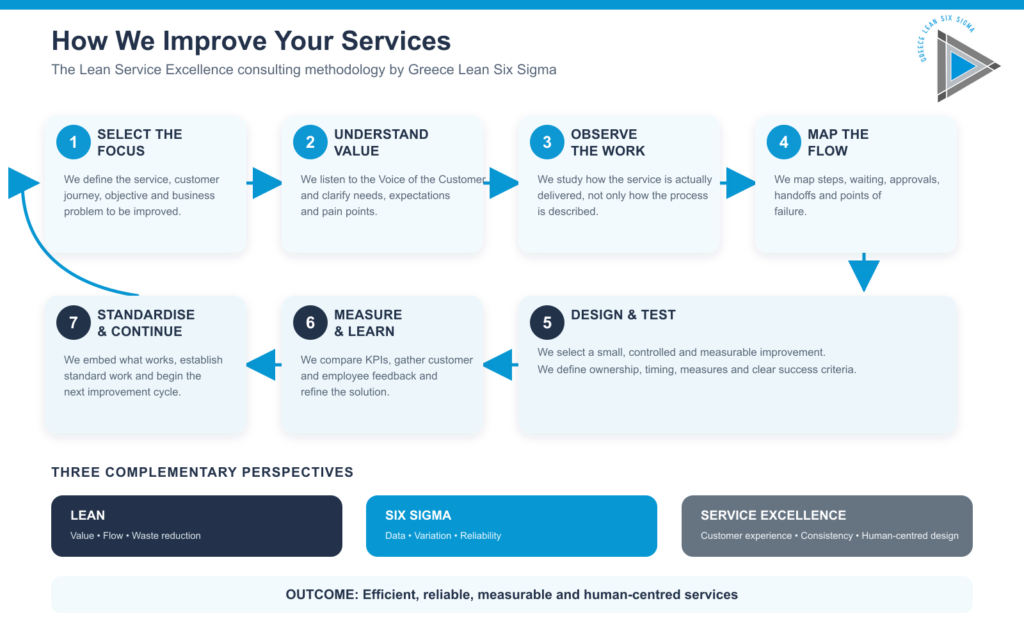
Select the focus
We define the specific service, customer journey or business process that requires improvement.
This may include a reservation process, check-in, request handling, quotation preparation, complaint management or technical support. We also clarify the business problem, project objectives, scope and expected outcomes.
Understand value
We listen to the Voice of the Customer and explore customer needs, expectations and pain points.
We also collect insights from the employees involved in the process. The people who perform the work every day often understand problems and opportunities that are not visible in reports or formal process descriptions.
Observe the real work
We study how the service is actually delivered, not only how the process is believed to operate.
We observe the flow of work, decisions, delays, exceptions, handoffs and situations in which employees need to create temporary workarounds to complete their tasks.
Map the flow
We document the current state of the process.
We identify:
- Value-creating activities
- Waiting and delays
- Unnecessary steps
- Repeated work
- Handoffs between teams
- Approvals that do not add value
- Causes of errors and rework
- Barriers to smooth process flow
- Critical customer touchpoints
Process mapping creates a shared understanding of the current situation. It also helps different departments understand how their work affects the complete service and customer experience.
Design and test
We select a small, controlled and measurable improvement.
Instead of beginning with a large and complex transformation, we test the proposed solution on a limited scale. We define clear ownership, timing, performance measures and success criteria.
The solution may include:
- Simplifying the process flow
- Removing unnecessary steps
- Reducing approvals and handoffs
- Improving the organisation of information
- Introducing visual management
- Clarifying roles and responsibilities
- Establishing standard work
- Introducing mistake-proofing mechanisms
- Redesigning customer touchpoints
Measure and learn
We compare the results with the initial situation and determine whether the change has created meaningful improvement.
Depending on the project, we may measure:
- Process lead time
- Customer waiting time
- First contact resolution
- Number of errors
- Rework rate
- Customer complaints
- Customer satisfaction
- Productivity
- Cost to serve
- Consistency of service delivery
- Employee experience
We gather feedback from customers and employees, evaluate the results and refine the solution where necessary.
Standardise and continue
When a change proves successful, we integrate it into the organisation’s normal way of working.
We establish standard work, appropriate procedures where required, performance indicators and mechanisms for identifying deviations early. The next cycle of improvement can then begin. Service excellence is not a one-time project. It is a long-term organisational capability.
Lean, Six Sigma and Service Excellence
The three perspectives work together.
Lean
Focuses on customer value, process flow and waste reduction. It helps teams simplify processes and reduce activities that consume time and effort without creating value.
Six Sigma
Focuses on variation, defects and evidence-based problem solving. It uses data to identify the true causes of a problem and confirm whether a change produces measurable improvement.
Service Excellence
Focuses on creating a consistently outstanding customer experience. It connects quality, reliability, empathy and human-centred design with the daily operation of the organisation.
Together, they create services that are efficient, reliable, measurable and human-centred.
Our consulting services
Greece Lean Six Sigma can support your organisation through a focused improvement initiative or a wider operational transformation programme.
Service and process assessment
We assess the current state, identify the most important sources of waste and determine the most significant opportunities for improvement.
Process and customer journey mapping
We map the flow of work and the customer journey, connecting the visible customer experience with the internal processes that support it.
Voice of the Customer analysis
We collect and analyse customer needs, expectations and pain points. We then translate these insights into clear and measurable service requirements.
Service design and process redesign
We design simpler and more effective processes with fewer delays, clearer responsibilities and a better experience for customers and employees.
Targeted problem solving
We apply structured Lean and Six Sigma methodologies to recurring service problems (see the list below).
Performance measurement
We help establish a balanced measurement system that connects customer experience, service quality, time, cost and process performance.
Team training and development
We train managers and employees in Lean Service Excellence principles and guide them as they apply the methodology to real organisational projects.
Implementation support
Our involvement does not end with a report or a list of recommendations. We support your teams during testing, implementation, measurement and standardisation, so improvements are practical, accepted by employees and sustainable over time.
Typical problems we solve
Where can Lean Service Excellence be applied?
Lean Service Excellence can be applied in any organisation that provides services to external or internal customers, including:
Expected benefits
A successful Lean Service Excellence implementation can contribute to:
- Shorter service delivery times
- Reduced waiting and fewer handoffs
- Fewer errors and less rework
- Higher first contact resolution
- Improved customer satisfaction and loyalty
- Lower operating costs
- Greater consistency in service quality
- Better cooperation between departments
- Clearer roles and responsibilities
- Higher employee involvement
- Stronger problem-solving capabilities
- A sustainable culture of continuous improvement
Training or consulting support?
The appropriate form of collaboration depends on your organisation’s objectives, challenges and level of improvement maturity.
Training
Suitable when you want to establish common knowledge, develop practical skills and introduce Lean Service Excellence principles to your teams.
Consulting support
Suitable when you have a specific service, customer journey or business process that requires detailed analysis and measurable improvement.
Combined approach
Training, practical application and coaching on a real organisational project. The organisation achieves immediate results while developing its own internal continuous improvement capability.
Start with one real challenge
You do not need to transform the entire organisation from the first day.
We can begin with one specific service, one customer journey or one critical process. Together, we will understand the current situation, identify the causes of the problem and design a practical and measurable solution.
Lean Service Excellence: frequently asked questions
What is Lean Service Excellence?
An integrated approach to service improvement that combines Lean principles, Six Sigma methodology and human-centred customer experience design, so services become faster, simpler and more reliable.
Which ISO standards relate to Service Excellence?
ISO 23592:2021 defines the principles and model of Service Excellence, and ISO/TS 23686:2022 specifies metrics and methods for measuring its performance. We help organisations connect these standards with their real processes.
Which industries can apply it?
Any organisation serving external or internal customers: hotels and tourism, banking and insurance, healthcare, technology, retail, logistics, the public sector, education, professional services and internal functions such as HR, IT and finance.
Which indicators do you track in a project?
Depending on the project: lead time and waiting time, first contact resolution, errors and rework, complaints, customer satisfaction, productivity, cost to serve and employee experience.
Where do we start?
With one specific service, one customer journey or one critical process. The first measurable results appear quickly and the team learns by doing, before the approach is extended across the organisation.
We never publish client names, logos, photographs or data. What we learn in your organisation stays there.
Contact Greece Lean Six Sigma
Talk to us about the service or process you want to improve. We will recommend the most appropriate form of collaboration, from a focused workshop to a complete Lean Service Excellence consulting project. Telephone: +30 231 231 5681, email: info@greeceleansixsigma.gr