For managers, supervisors and teams who want to apply what they learn in their daily work. No prior knowledge is required unless the description says otherwise.
Lean Six Sigma for Logistics, Ports and Shipping | Live Online 2027
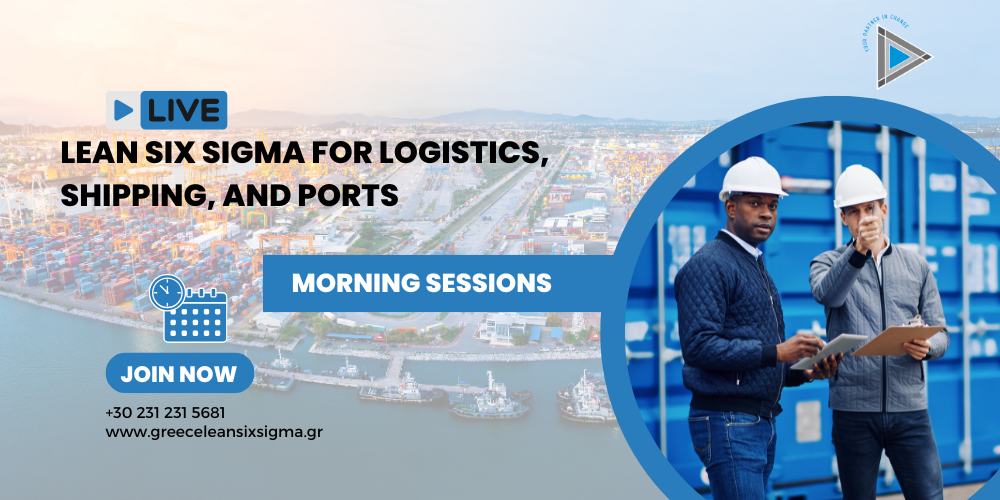
Event Description
Prefer English? Ask us about delivery in English for your team. Contact us →
Lean Six Sigma for Logistics, Ports and Shipping | Live Online
A practical 32-hour programme that applies the Lean Six Sigma methodology (DMAIC) to real problems in ports, terminals, shipping companies, warehouses and transport, and prepares you to sit a Lean Six Sigma Yellow Belt certification exam afterwards.
Berth congestion, vessel delays, long truck waiting times at the gate, container handling errors, under-used equipment and yard space: these are process problems, not only infrastructure problems. In this programme you learn to define them, measure them with data, find the root causes and keep the improvement in place over time.
The content is built on the Lean Six Sigma Yellow Belt Body of Knowledge, with examples taken entirely from supply chain, shipping and port operations.
At a glance
| Duration | 32 didactic hours (4 sessions × 6 didactic hours + 1 Saturday session × 8 didactic hours), with a dummy project throughout |
| Format | Live Online, instructor-led, with interactive workshops and exercises |
| Language | Public cohorts are delivered in Greek. English cohorts and in-house delivery in English are available on request. |
| Prerequisites | None – no prior Lean Six Sigma or statistics knowledge required |
| Tools | Excel / Google Sheets (ready-made GLSS templates) |
| On completion | GLSS certificate of attendance and digital badge |
| Next step | Lean Six Sigma Yellow Belt certification exam (not included – see “Certification”) |
Training cycles
March 2027 – morning cycle
Wednesday 3/3, Friday 5/3, Wednesday 10/3, Friday 12/3 (09:00–14:00) · Saturday 13/3/2027 (09:00–15:30)
May 2027 – afternoon cycle
Wednesday 19/5, Friday 21/5, Wednesday 26/5, Friday 28/5 (17:00–22:00) · Saturday 29/5/2027 (09:00–15:30)
October 2027 – morning cycle
Wednesday 6/10, Friday 8/10, Wednesday 13/10, Friday 15/10 (09:00–14:00) · Saturday 16/10/2027 (09:00–15:30)
November 2027 – afternoon cycle
Wednesday 17/11, Friday 19/11, Wednesday 24/11, Friday 26/11 (17:00–22:00) · Saturday 27/11/2027 (09:00–15:30)
Times are Greek time (EET/EEST). A didactic hour is 45 minutes, with a 15-minute break every two didactic hours.
Who should attend
- Managers and staff of port authorities and container, bulk and passenger terminals
- Professionals in shipping companies, ship agencies and fleet management
- Freight forwarders, 3PL/4PL providers, warehouse and road transport companies
- Supply chain, procurement and planning managers in industry and trade
- Operations, quality, continuous improvement and digital transformation managers
- Anyone aiming for Lean Six Sigma Yellow Belt certification with examples from their own sector
What you will be able to do
- Explain Lean and Six Sigma principles, the DMAIC methodology and the roles in an improvement project (Yellow, Green, Black Belt, Champion).
- Translate the Voice of the Customer (shipowner, shipper, consignee) into measurable Critical-to-Quality requirements (CTQs) and draft a Project Charter.
- Map processes (SIPOC, flowchart, Value Stream Map) and spot the 8 wastes in the warehouse, gate, yard and berth.
- Collect and analyse operational data using basic statistics, charts and process capability measures (DPMO, Sigma level, Cp, Cpk).
- Check the reliability of your data (basics of Measurement System Analysis – MSA).
- Find root causes with Pareto, Ishikawa, 5 Whys, scatter diagrams and FMEA.
- Apply control and sustain tools: 5S, Kanban, Poka-Yoke, standard work, visual management and the Control Plan.
- Link improvement to sustainable logistics, port energy efficiency and digital data (TOS, WMS, IoT, AI).
Detailed agenda
Throughout the programme you work on a dummy project from a container terminal, so every tool is applied straight away to a realistic sector scenario.
Session 1 – Define: Lean Six Sigma foundations and problem definition (6 hours)
- Lean and Six Sigma: history, principles, variation and waste
- The DMAIC methodology and roles (Yellow, Green, Black Belt, Champion, Process Owner)
- Sector challenges: port congestion, schedule reliability, the connected supply chain
- Voice of the Customer (VOC), Kano and the CTQ tree
- Key sector KPIs: vessel turnaround time, crane moves per hour, truck turnaround time, dwell time, OTIF, inventory accuracy
- Project selection and the Project Charter
- Workshop: SIPOC and Project Charter for the dummy project (the port call process)
Session 2 – Measure I: Process mapping and waste elimination (6 hours)
- Value-added and non-value-added activities
- The 8 wastes (TIMWOODS) in the warehouse, terminal gate, container yard and ship agency
- Flowcharts, swimlanes and Value Stream Mapping basics
- From symptoms to variables: the X-Y (cause-and-effect) matrix
- Data types and the data collection plan
- Workshop: mapping the truck gate-in process and identifying waste
Session 3 – Measure II: Statistics, data reliability and process capability (6 hours)
- Basic and descriptive statistics: mean, median, standard deviation, range
- The normal distribution and graphical analysis: histogram, box plot, run chart
- Data reliability: MSA basics (e.g. timestamps in TOS/WMS)
- Process capability: DPMO, Sigma level, Cp and Cpk
- Workshop: analysing real vessel turnaround data in Excel / Google Sheets
Session 4 – Analyze: Finding root causes (6 hours)
- Patterns of variation: common and special causes
- Pareto analysis and data stratification
- Ishikawa diagram and 5 Whys
- Scatter diagrams and correlation
- FMEA for logistics operations: prioritising risks
- Workshop: root causes of truck waiting time at the gate
Session 5 – Improve and Control: Improvement, sustaining results and exam preparation (8 hours, Saturday)
- Improvement techniques, Kaizen, solution selection (impact-effort matrix) and piloting
- Lean control tools: 5S, Kanban, Poka-Yoke, standard work, visual management
- The Control Plan and an introduction to Statistical Process Control (SPC)
- Sustainable logistics and port energy efficiency
- Digital Lean Six Sigma: TOS/WMS data, Port Community Systems, IoT and AI in improvement
- Final workshop: dummy project presentation and an improvement plan for your team
- Review of the Yellow Belt Body of Knowledge, mock exam and exam guidance
Lean Six Sigma Yellow Belt certification
The programme covers the Yellow Belt Body of Knowledge (Define, Measure, Analyze, Improve, Control) applied to your sector. Once you complete it, you can sit a Yellow Belt certification exam with the body of your choice, for example:
- IASSC (via PeopleCert), CSSC or ILSSI – bodies GLSS partners with
- ASQ (Certified Six Sigma Yellow Belt) – exams are taken directly with ASQ
Important: the certification exam is not included in the tuition fee. Exams are separate from training and their cost depends on the certifying body you choose. We will guide you through the choice and the registration process.
Tuition and discount policy
| Cycle | Tuition | Early booking |
|---|---|---|
| 2027 cycles | €890 | €790 when you register and pay at least 30 days before the start |
All prices are final – GLSS does not charge VAT.
One discount per registration – the largest you qualify for. Discounts cannot be combined.
| Discount | Rate / price | Condition |
|---|---|---|
| Early booking | €790 | Register and pay at least 30 days before the start |
| Group / company registration | 15% | 4 or more participants from the same organisation – contact us to register |
| Single payment | 5% | Full tuition paid at registration |
| GLSS alumni | 10% | Graduates of GLSS programmes |
| Special categories | 10% | Unemployed, people with disabilities, large families, single-parent families – proof required |
Payment methods: bank transfer, debit/credit card (Alpha Bank), PayPal / Google Pay. Up to 3 interest-free instalments through Alpha Bank.
Full details: GLSS discount policy
Terms
- The certificate of attendance is issued once tuition is paid in full.
- Refunds are given only if GLSS cancels the cycle.
- GLSS may change dates or instructors, and may postpone a cycle if enrolment is too low.
In-house training
The programme can be tailored to the processes and data of your port, terminal, shipping company or distribution centre, in person or Live Online, in Greece, Cyprus and Europe, in Greek or English. It can be combined with improvement project coaching. Request a proposal.
Frequently asked questions
Can I sit a Lean Six Sigma Yellow Belt exam after this programme?
Yes. The programme has the same length as the GLSS Yellow Belt (32 didactic hours), is built on the Yellow Belt Body of Knowledge and includes a mock exam and exam guidance. You can sit the exam with IASSC, CSSC, ILSSI or ASQ. The exam is not included in the tuition fee.
How is it different from the general GLSS Lean Six Sigma Yellow Belt?
Both are 32 didactic hours and cover the same Body of Knowledge. The general Yellow Belt is for all sectors (industry and services). This programme uses only examples, KPIs, data and a dummy project from logistics, ports and shipping.
Do I need a statistics background?
No. Statistics is taught from the start, with practical examples in Excel / Google Sheets.
What comes after Yellow Belt?
Lean Six Sigma Green Belt, so you can lead DMAIC improvement projects in your organisation.
Is the programme available in English?
Public cycles are delivered in Greek. For an English cycle or in-house training in English, register your interest.
Where do participants come from?
Greece, Cyprus and across Europe – managers, supervisors and teams from ports, shipping, logistics and industry.
Related courses
- Lean Six Sigma Yellow Belt
- Lean Six Sigma Green Belt
- Lean Logistics: Warehouse and Supply Chain Excellence
- KPI Implementation: Designing and Deploying KPIs
- Lean Procurement and Supplier Development
Contact: info@greeceleansixsigma.gr · +30 231 231 5681
Συχνές ερωτήσεις
Answers to the most frequently asked questions about the programme.
Who is this programme for?
How is the training delivered?
Live Online, with the trainer, exercises and examples, for participants from Greece, Cyprus and Europe.
Is the certification exam included?
No. The certification exam is not included and is taken separately, depending on the certification body you choose.
Can the programme run in-house?
Yes. The programme can also run in-house, in a classroom or Live Online, with examples from your own operation.
How do discounts work?
One discount applies per registration, the largest you qualify for. See the discount policy.
Νοέ
04

Virtual
Νοέ
05
Virtual
Ιαν
18
Multi Date
Virtual
Σεπ
28
Multi Date
Virtual
Μαρ
01
Multi Date
Virtual
Οκτ
21

Virtual
Φεβ
08
Multi Date
Virtual
Νοέ
16
Virtual
Ιαν
11
Multi Date
Virtual
Μάι
13
Multi Date
Virtual
Φεβ
01

Multi Date
Virtual
Δεκ
11
Virtual
Σεπ
13

Virtual
Φεβ
24

Multi Date
Virtual
Νοέ
10

Virtual
Νοέ
23

Virtual
Οκτ
20

Virtual
Οκτ
27

Virtual
Οκτ
16

Virtual
Νοέ
03

Virtual